
The net financial savings of the household sector has moderated to 5.1% of GDP in FY23 from 7.6 per cent in FY20, as households shifted their savings to physical assets amid low interest rates during the pandemic, according to State Bank of India's (SBI) Research report.

Showing the effect of the slowdown in global economic activity, the equity foreign direct investment (FDI) into India declined sharply to $13.9 billion in April-July 2023 from $22.04 billion a year ago. The net FDI, inflows minus outflows, declined from $17.28 billion in April-July 2022 to $5.70 billion in April-July 2023 on account of moderating gross FDI and a rise in repatriation. Gross FDI into India moderated to $22.0 billion during April-July 2023 from $29.6 billion a year ago, according to Reserve Bank of India data.

The Reserve Bank of India's (RBI's) decision to withdraw the incremental cash reserve ratio (I-CRR) is expected to benefit banks during the festival season. They are likely to increase deposit rates by up to 25 basis points (bps) in select maturity buckets. The rise in demand for funds to cover tax payments and meet quarter-end business targets could influence rate decisions by banks, according to bankers and money market executives.
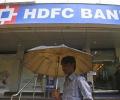
Shares of HDFC Bank will witness massive inflows totalling $600 million from passive trackers this week, predict analysts. This influx is attributed to the rebalancing activities in the S&B BSE Sensex and the Financial Times Stock Exchange (FTSE) indices. The Sensex is set for its quarterly rebalancing act on September 15 (date of adjustment), resulting in inflows of $102 million (approximately Rs 850 crore).

Reflecting subdued global economic growth, India's outward foreign direct investment (FDI) fell by 33.3 per cent sequentially to $1.21 billion in August, compared to over $1.82 billion in July.

The OCCRP report alleges that at one point, EIFF and EMRF held free-floating shares ranging from 8 per cent to nearly 14 per cent in the four Adani Group companies.

As a step to entrench its consumer finance business, Bajaj Finance (BFL) plans to scale up its business-to-business (B2B) activity, both in terms of volume as well as value. It plans to add up to 1,000 cities in the next three years and this will mark its presence in around 5,000 cities. The expansion activity will be more in Northern and Eastern India.

Polycab India, Power Finance Corporation, Shriram Finance, and Union Bank of India appear poised to transition from the mid-cap to the large-cap category within the domestic mutual fund industry. Their market capitalisation (m-cap) now ranks among the top 100, which is the threshold for the large-cap universe defined by the Securities and Exchange Board of India.

Lenders in India, comprising banks and finance companies, anticipate robust growth in retail credit during the upcoming festival season, stretching from September to December 2023. This expectation is based on resilient demand, government initiatives, and elections in key states.
Interrupting a two-month streak of decline, outward foreign direct investment (FDI) rose sequentially to $1.85 billion in July over $1.07 billion in June, an increase of 73 per cent. However, it was lower than the $2.18 billion in July last year, according to the Reserve Bank of India data. Outbound FDI, expressed as financial commitment, has three components - equity, loans, and guarantees.

A new regulation concerning the disclosure of family arrangements by listed companies is exacerbating rifts between feuding shareholders. The latest example is Bengaluru-based TD Power Systems (TDPS), currently enmeshed in a legal dispute before the Karnataka high court over ownership of its 16 per cent equity. Vijay Kirloskar, who is asserting a claim over the 16 per cent stake held by Mohib Khericha (chairperson of TDPS) and Nikhil Kumar (managing director of TDPS and nephew of Kirloskar), has sent a letter to the market regulator, Securities and Exchange Board of India (Sebi), and stock exchanges. He accuses TDPS of insufficient disclosure concerning shareholder agreements.

The sectors that received most of the investment during this period included manufacturing, financial services, business services, computer services, electricity, and other energy sectors.

The flow of money into Non-Resident Indians (NRIs) deposits witnessed a substantial increase, touching $2.14 billion in the first quarter of this financial year (Q1FY24), compared with $349 million in the same period in FY23. The outstanding NRI deposits rose by $2.5 billion, standing at $141.28 billion at the end of June 2023, up from $138.77 billion in May 2023, according to Reserve Bank of India (RBI) data. RBI released the updated data in the bulletin after almost three months.

The shift to a shorter T+3 settlement cycle for initial public offerings (IPOs) will be a big test of the domestic market structure, requiring players in the ecosystem to work harder to meet the squeezed timelines, according to industry insiders. The Securities and Exchange Board of India (Sebi), has announced that the transition to the T+3 cycle will be voluntary starting next month and mandatory from December 1. The new mechanism will necessitate quicker confirmations from banks and speedy verification of permanent account numbers (PANs) for all applicants.

The per capita income of Indians as gleaned from income-tax filing is expected to increase from Rs 2 lakh in FY23 to Rs 14.9 lakh in FY47, coinciding with 100 years of the country's Independence, according to SBI Research. In dollar terms it will increase from about $2,500 in FY23 to $12,400 in FY47. Soumya Kanti Ghosh, group chief economic adviser, State Bank of India, said the weighted mean income was Rs 4.4 lakh in AY14. That rose to Rs 13 lakh in FY23.

Companies, which missed out on listing earlier, are giving it another shot but with significantly-reduced issue sizes. In the recent past, companies such as TVS Supply Chain Solutions, Suraj Estate Developers, and ESAF Small Finance Bank have re-filed their draft red herring prospectuses (DRHPs) with the Securities and Exchange Board of India (Sebi). This came after they slashed their issue sizes by 20-60 per cent.

Jio Financial Services, a unit of Mukesh Ambani's Reliance Industries (RIL), got valued at Rs 1.66 trillion ($20 billion) following an hour-long special trading session conducted by stock exchanges on Thursday. Shares of RIL's unit got priced at Rs 261.85 apiece - higher than analysts' expectations of Rs 134-224 per share. The price was arrived at after calculating the difference between RIL's Wednesday (July 19) close of Rs 2,840 and Rs 2,580, the price discovered during the first-of-its-kind pre-trade session.

Following a more than 15 per cent surge in the National Stock Exchange (NSE) Nifty 50 from this year's lows, the spread between the 10-year government security (G-sec) and the Nifty earnings has approached the danger zone of 2 percentage points (ppt). At present, the G-sec yield is roughly 7.09 per cent, while the Nifty earnings are 5.12 per cent. As a result, the spread works out to 1.98 ppt, ever so slightly below the danger mark of 2 ppt.
India's outward Foreign Direct Investment (FDI) nosedived to $11.12 billion in January-June (H1 2023) from $23.57 billion in the same period last year, indicative of the slowdown in the global economy, according to the Reserve Bank of India (RBI) data. The outward FDI expressed as the total financial commitment, has three components, namely equity, loan and guarantees. The sharp contraction in the commitments (outward FDI) was prominent in the April-June 2023 period.
Foreign portfolio investors (FPIs) are likely to get a reprieve from the Securities and Exchange Board of India (Sebi) in case of a passive or unintended breach of the thresholds that trigger additional disclosure norms. According to sources, FPIs whose single group exposure exceeds 50 per cent of their corpus will get 10 trading days to bring down their exposure below the prescribed level, without triggering the stricter disclosure norms. If total equity exposure of an overseas fund exceeds Rs 25,000 crore and it doesn't wish to provide additional disclosures, it will have three months to pare its exposure.
 © 2026 Rediff.com - Advertise with us - Disclaimer - Privacy Policy - Sitemap - Feedback - About us - Terms of use - Grievances